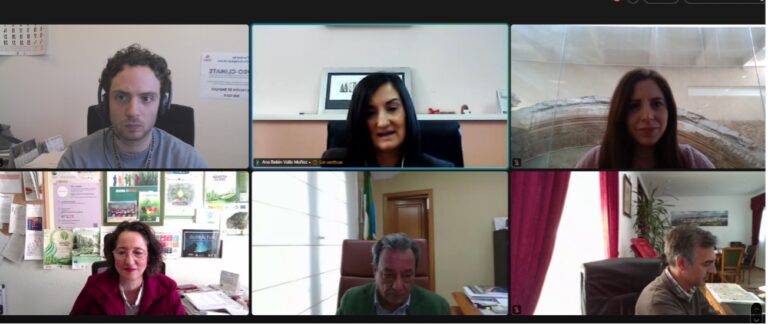
As part of the round of bilateral workshops that the Badajoz Province LL is organising within PRO-CLIMATE, a participatory online session with the Federation of Municipalities and Provinces of Extremadura (FEMPEX) was held on 16 March 2026, bringing together local representatives to explore practical pathways for climate change adaptation at the municipal level.
The municipalities represented were Valdivia, Higuera La Real, Valencia de las Torres, Puebla de la Calzada and Fuente del Arco. The session aligned with PRO-CLIMATE’s approach of fostering proactive adaptation through social transformation and behavioural change, recognising local authorities as key drivers of climate action. In a region particularly vulnerable to rising temperatures, irregular rainfall and increasing risks of drought and wildfires, the workshop provided a space to reflect on real challenges and identify actionable solutions. Discussions highlighted the strong connection between municipal work and climate adaptation, particularly in areas such as environmental awareness, waste management and water efficiency. Participants emphasised the importance of combining citizen engagement with data-driven tools (such as smart monitoring systems) to improve resource management and encourage behavioural change. Training and capacity building emerged as key levers for change, alongside the need to improve local infrastructure and access specialised technical support. Collaboration was also identified as essential, with FEMPEX, provincial bodies and other supra-municipal entities playing a crucial role in enabling action, especially in smaller municipalities. The workshop resulted in a shared roadmap structured across short-, medium- and long-term actions, ranging from awareness-raising initiatives and ongoing local projects to structural investments requiring broader institutional support.
Overall, the session reinforced the importance of coordinated, locally driven approaches to climate adaptation, positioning municipalities as key agents of change in building resilient rural territories.