
Introduction
The Zakynthos Living Lab (LL), part of the Horizon Europe PRO-CLIMATE project, serves as a real-world innovation platform for fostering inclusive and participatory climate adaptation on a Mediterranean island with a dynamic tourism sector that interacts closely with local resources and infrastructure.
Zakynthos is increasingly affected by seasonal water shortages, rising temperatures, and the impacts of concentrated tourist activity. These pressures coincide with institutional fragmentation, gaps in public awareness, and limited civic involvement. The LL attempts to address these challenges by encouraging behavioural change, building local knowledge, promoting sustainability values, and facilitating cooperation among public authorities, civil society, and the tourism sector.
The activities of the Zakynthos LL are developed with the support of Co-opAbility, which plays a key role in local facilitation, coordination, and stakeholder mobilisation. Technical and methodological guidance is provided by Atlantic Technological University (ATU) and Coventry University (CU), in line with the overall structure and objectives of the PRO-CLIMATE project. The LL also benefits from interacting with municipal bodies, regional authorities, environmental NGOs, academic actors such as the Ionian University, and representatives of the private sector.
Key Contextual Challenges in the Zakynthos Living Lab
Environmental pressures
➚ Water scarcity and reduced precipitation intensify seasonal stress on water systems.
➚ Rising temperatures challenge biodiversity, local production and public health.
➚ Sea level rise and coastal erosion put pressure on areas supporting key economic activities, Natura 2000 sites, and nesting beaches.
Socio-Economic Dynamics
➚ High dependency on seasonal tourism amplifies economic and ecological vulnerability.
➚ Decline in primary/secondary sectors reduces local resilience.
Opportunities for Systemic Change
The contextual assessment highlights the following priority areas where targeted action can foster climate resilience and behavioural transformation in Zakynthos, through the prism of promoting sustainable tourism:
- Tourism Profile Diversification: Expanding eco-tourism, promoting low-impact thematic travel (e.g., agro-tourism, cultural trails), and increasing off-season offerings can ease peak-period pressures and create more stable income streams. Local agricultural products with geographical indications—such as Zakynthos PGI raisins, PDO olive oil, and traditional wines—can be more strongly integrated into the tourism economy.
- Education and Awareness Raising: Building public understanding of climate risks and sustainable behaviours across all segments—residents, visitors, tourism businesses, and youth—is essential. This includes campaigns, workshops, and collaboration with the hospitality sector.
These leverage points form the foundation of the Zakynthos Living Lab’s strategic approach, guiding stakeholder engagement and the design of pilot actions under the PRO-CLIMATE project.
Stakeholder Landscape and Roles
The stakeholder mapping process in the Zakynthos Living Lab (LL) followed a relational and context-specific methodology, designed to support inclusive climate adaptation and improve governance capacity in a tourism-dependent Mediterranean island. In line with the Quadruple Helix model, the mapping identified a diverse spectrum of actors across public administration, academia and research, civil society, and the private sector—each contributing unique knowledge, responsibilities, and influence in shaping the island’s resilience trajectory.
The Living Lab draws on complementary expertise from project partners. The Ionian University contributes scientific perspectives on environmental systems and sustainability. Atlantic Technological University (ATU) provides methodological guidance consistent with the PRO-CLIMATE framework. Co-opAbility plays a central role in shaping and facilitating the participatory dimension of the Living Lab, applying its experience in co-creation, community engagement, and collaborative decision-making to ensure that the process remains inclusive, practice-driven, and responsive to stakeholder needs.
Civil society plays a significant role through both local and broader organisations. Such groups are active in public awareness campaigns, environmental education, and conservation advocacy, serving as intermediaries between institutions and local communities.
The private sector is predominantly represented by tourism enterprises alongside local food producers and agricultural cooperatives. Some actors are involved in the Local Tourism Committee, reflecting growing interest in sustainability-oriented tourism governance.
Residents, small-scale farmers, seasonal workers, and tourists form part of the broader stakeholder ecosystem. While often excluded from formal decision-making, their experiences and behaviours are crucial to the success of any adaptation strategy. The LL also aims to promote inclusiveness in this regard too.
Overall, to promote inclusiveness and transparency, the Zakynthos LL has employed various participatory mechanisms, including stakeholder workshops, bilateral meetings, and digital communication channels. The initiative also created a visual identity (logo) to increase visibility and foster community ownership of the Living Lab process.
Relevant news items
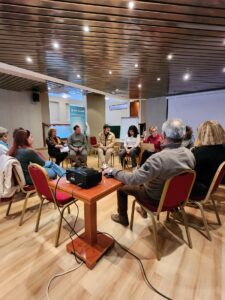
Living Lab Workshop in Zakynthos Tackles Sustainable Tourism and Climate Resilience
A Living Lab (LL) workshop was held in Zakynthos, Greece, in February as part of the PRO-CLIMATE Project. The two-day workshop brought together local stakeholders